Woodstock's weird weather
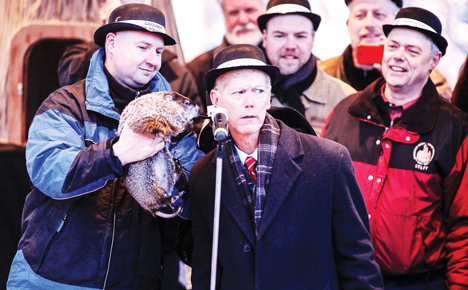
On a morning with temperatures in the 20s and a light layer of snow, Woodstock’s most famous weatherman, Woodstock Willie, predicted an early spring during the Feb. 2 Groundhog Day prognostication.
Emerging from his tree stump “reluctantly, but alertly,” Willie spoke to Mayor Brian Sager in Groundhogese. The hundreds in attendance let out a cheer when it was announced that Willie did not see his shadow, meaning an early spring is upon us.
Northern Illinois University staff meteorologist Gilbert Sebenste isn’t so sure that’s the case, however. While December and January in northern Illinois have been some of the mildest months on record, Sebenste said a change in the weather pattern could bring more precipitation in February and March. If temperatures stay at or below freezing, more snow could be coming over the next few weeks.
Sebenste said the amount of precipitation in January is about double the normal levels, though much of it has been received in the form of rain rather than snow due to the unusually high temperatures.
“The amount of moisture we saw was pretty impressive,” Sebenste said, referring to Jan. 29, when temperatures climbed as high as 60 degrees. “The past week or so we’ve gained a couple of inches of rainfall.”
In the span of about 60 hours, temperatures in some areas of northern Illinois dropped as much as 60 to 65 degrees while windchill levels dropped as much as 85 degrees. Sebenste said that dramatic of a temperature shift was unprecedented for the area.
In Woodstock, the constant weather change combined with the increased precipitation in January has wreaked havoc on the roads, said Jeff Van Landuyt, assistant director of public works.
“This winter has been tough on roads because of the amount of precipitation and the freeze/thaw cycle,” the Public Works Department stated in a release. “Potholes are formed when moisture gets beneath the surface of the roadway, freezes and expands ... causing the pavement to expand, bend or crack.”
When the ice melts, the pavement contracts and leaves gaps in the subsurface under the pavement where water can reach again. As the weight of cars drive over the weakened road, pieces begin to break up and cause potholes. Van Landuyt said the streets division has been busy filling potholes over the past few weeks when its employees are not plowing snow. Residents can call public works at 815-338-6118 to report potholes.
While the increased precipitation has caused challenges for some, the excess water is much needed in Illinois.
For 2012, Sebenste said the northern Illinois region was down 16 inches of precipitation from the average year. He said southern and central McHenry County were among the hardest hit by the drought. Sebenste said the Dust Bowl years in the 1930s and the beginning to the mid-1950s are the only years with more severe droughts.
“We’re hoping the water will gradually be replenished,” Sebenste said.
Using history as a guide, Sebenste said the area should receive more precipitation this year. How much more is the real question, however.
Meanwhile, the unusual temperatures and lack of snow have left outdoor winter enthusiasts without many options. The city has been unable to open the ponds at Emricson Park, and sledding or cross-country skiing opportunities have been limited.
The Chicago area received about 3 inches of snow Feb. 4, the largest amount of snowfall this season. Snow and rain is expected this week, and temperature highs are expected in the high 20s to low 30s.
Email
Print